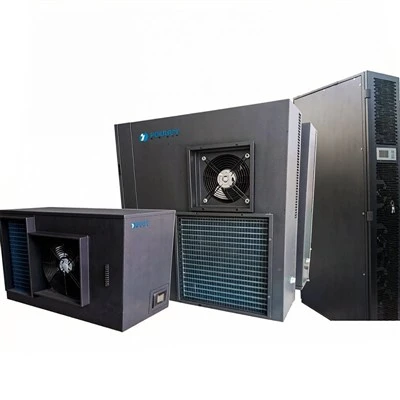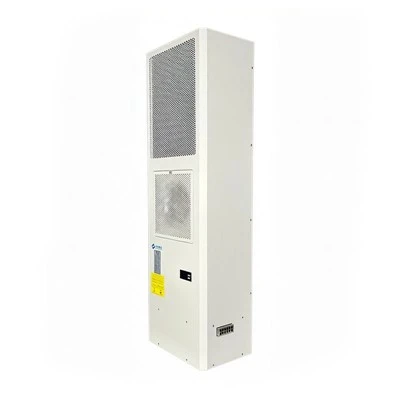

A complete cooling unit system may include:
- Refrigeration unit
- Temperature controller
- Temperature sensor
- Air outlet and return air inlet
- Air filter
- Drainage pipe
- Signal output or alarm interface
- Power cable and protection device
Not every project needs all items. The configuration depends on cabinet quantity, heat generation, and monitoring requirements.
Cooling capacity must match the total heat generation inside the cabinet. Selection steps:
- List all heat-generating components
- Add their rated power loss
- Add 20%–30% margin for future load increase
- Compare with the unit rated cooling capacity at actual ambient temperature
If the ambient temperature is high, the actual cooling capacity is lower than the rated value. In this case, select one size larger.
For cabinets with stable heat load, a single unit is usually sufficient. For cabinets with:
- Large heat load fluctuation
- High ambient temperature
- Requirement for continuous operation
- Requirement for redundancy
a dual-unit configuration can be considered. Two units can run alternately or run together depending on the temperature controller setting.
The temperature controller can be set with:
- Target cabinet internal temperature
- Temperature difference (hysteresis)
- Alarm high limit
- Alarm low limit
- Compressor delay time
Recommended cabinet internal temperature range: +25°C to +38°C. If the set temperature is too low, condensate may form on the evaporator and energy consumption increases.
The unit can be configured with different operation modes:
|
Mode |
Description |
|
Automatic |
Unit starts and stops by cabinet internal temperature |
|
Manual |
Unit runs continuously regardless of temperature |
|
Timer |
Unit runs in set time periods |
|
Remote |
Unit controlled by external signal or monitoring system |
Mode selection depends on the process requirement and monitoring system.
The unit can be configured with signal output and alarm interfaces. Typical alarm conditions:
- Cabinet internal temperature above high limit
- Cabinet internal temperature below low limit
- Temperature sensor failure
- Power supply failure
- Compressor overload
For connection to an existing PLC or monitoring system, confirm the interface type and communication protocol at order confirmation.
To evaluate energy consumption, record:
- Unit running hours per day
- Compressor start and stop frequency
- Ambient temperature
- Cabinet internal temperature
- Input power or running current
If the compressor starts and stops frequently, check the temperature difference setting and cabinet heat load fluctuation.
Recommended maintenance schedule:
|
Interval |
Item |
|
Monthly |
Clean air inlet filter, check drainage pipe |
|
Quarterly |
Check running current, check sealing gasket |
|
Every 6 months |
Check temperature sensor, check fan blade |
|
Every 12 months |
Check refrigerant charge, check electrical connections |
Recommended consumables and spare parts:
- Air inlet filter
- Sealing gasket
- Drainage pipe
- Temperature sensor
- Fan
|
Symptom |
Possible Cause |
|
Cabinet temperature too high |
Filter blockage, ambient temperature, heat load increase |
|
Compressor frequent start/stop |
Temperature difference too small, heat load fluctuation |
|
Water inside cabinet |
Drainage pipe blocked, sealing gasket damaged |
|
Unit does not start |
Power supply, voltage, temperature controller setting |
|
Alarm output always active |
Sensor failure, wiring error, alarm setting |
Standard Configuration (Selected Models)
|
Parameter |
Unit |
SAS300 |
SAS600 |
SAH1000 |
SAH2000 |
SAH3200 |
|
Cooling capacity |
W |
300 |
600 |
1000 |
2000 |
3200 |
|
Cabinet internal temperature range |
°C |
+25 to +38 |
+25 to +38 |
+25 to +38 |
+25 to +38 |
+25 to +38 |
|
Cabinet external temperature range |
°C |
-5 to +55 |
-5 to +55 |
-5 to +55 |
-5 to +55 |
-5 to +55 |
|
Power supply |
V/ph/Hz |
220/1/50 |
220/1/50 |
220/1/50 |
220/1/50 |
220/1/50 |
|
Protection level (internal/external) |
IP |
IP54 |
IP54 |
IP54 |
IP54 |
IP55/IP55 |
Q: How often does the compressor start and stop during normal operation?
A: The compressor start and stop frequency depends on the temperature difference setting, cabinet heat load, and ambient temperature. If the compressor starts and stops more than 6 times per hour, check the temperature difference setting and whether the cooling capacity is too large for the actual heat load.
Q: What should be recorded during daily operation?
A: Record cabinet internal temperature, ambient temperature, unit running hours, compressor start and stop frequency, and running current. Compare the record with the design value. If the cabinet internal temperature rises gradually, check the air inlet filter, condenser fins, and actual heat load.
Hot Tags: cabinet cooling unit, China cabinet cooling unit manufacturers, suppliers, factory, Air Conditioning Fresh Air Unit, cabinet air conditioner control panel, cabinet air conditioner with thermostat, control enclosure air conditioner, Dc Cabinet Air Conditioner, frequency converter cabinet air conditioner