
Hey there! As a supplier of industrial screw compressors, I've been getting a ton of questions lately about the ventilation requirements for an industrial screw compressor room. So, I thought I'd take a moment to break it all down for you.
First off, let's talk about why ventilation is so important in the first place. Industrial screw compressors generate a significant amount of heat during operation. If this heat isn't properly dissipated, it can lead to a whole host of problems. For starters, high temperatures can reduce the efficiency of the compressor. When the compressor has to work harder due to excessive heat, it consumes more energy, which means higher operating costs for you.
Moreover, overheating can cause premature wear and tear on the compressor's components. This can lead to frequent breakdowns and costly repairs. In the worst - case scenario, it could even result in a complete compressor failure, which would bring your operations to a grinding halt.
Now, let's get into the nitty - gritty of the ventilation requirements. The amount of ventilation needed depends on several factors, including the size and power of the compressor, the ambient temperature of the room, and the type of work the compressor is doing.
Compressor Size and Power
The larger and more powerful the compressor, the more heat it will generate. For example, a high - capacity industrial screw compressor used in a large manufacturing plant will produce a lot more heat than a smaller compressor used in a small workshop. As a general rule, you'll need more ventilation for bigger compressors.
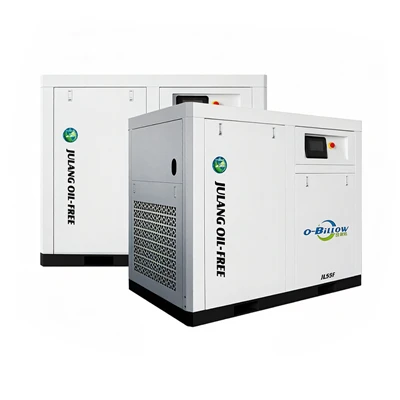
If you're using a High Pressure Screw Air Compressor, which typically has a higher power output, you'll need to ensure that the ventilation system can handle the increased heat load. These compressors are designed to operate at high pressures, and this often means they generate more heat during compression.
Ambient Temperature
The ambient temperature of the compressor room also plays a crucial role. If the room is located in a hot climate or if there are other heat - generating sources in the vicinity, the ventilation system will need to work harder to keep the compressor cool.
For instance, if your compressor room is in a building where there are large furnaces or other industrial equipment that produce heat, the ambient temperature in the room will be higher. In this case, you'll need to increase the ventilation rate to counteract the additional heat.
Type of Work
The type of work the compressor is doing can also affect the ventilation requirements. If the compressor is running continuously at full capacity, it will generate more heat than if it's operating intermittently or at a lower capacity.
For example, a compressor used in a continuous manufacturing process, such as in a food processing plant, will need more ventilation compared to a compressor that's only used occasionally for tasks like inflating tires in a small garage.
Calculating the Ventilation Requirements
So, how do you calculate the ventilation requirements for your industrial screw compressor room? Well, there are a few steps involved.
First, you need to determine the heat load generated by the compressor. This can be done by referring to the compressor's technical specifications. Most manufacturers provide information on the heat output of their compressors in terms of kilowatts (kW).
Once you know the heat load, you need to calculate the amount of air required to remove this heat. The general formula for calculating the required air volume is:
$Q = \frac{H}{C_p \times \Delta T}$
Where:
- $Q$ is the required air volume in cubic meters per second ($m^3/s$)
- $H$ is the heat load in kilowatts (kW)
- $C_p$ is the specific heat capacity of air, which is approximately 1.005 kJ/(kg·K)
- $\Delta T$ is the temperature difference between the inlet and outlet air
For example, if your compressor has a heat load of 10 kW and you want to maintain a temperature difference of 10°C between the inlet and outlet air, the calculation would be as follows:
First, convert the heat load from kilowatts to kilojoules per second: $H = 10 \text{ kW}=10 \text{ kJ/s}$
$Q=\frac{10}{1.005\times10}\approx 0.995 m^3/s$


This means you would need to supply approximately 0.995 cubic meters of air per second to remove the heat generated by the compressor.
Ventilation System Design
Now that you know how much air you need to supply, it's time to design the ventilation system. There are two main types of ventilation systems: natural ventilation and mechanical ventilation.
Natural Ventilation
Natural ventilation relies on the movement of air due to differences in temperature and pressure. This can be achieved through the use of windows, vents, and louvers. Natural ventilation is a cost - effective option, but it may not be sufficient for larger compressor rooms or in areas with high ambient temperatures.
Mechanical Ventilation
Mechanical ventilation uses fans and ducts to move air in and out of the room. This type of ventilation system provides more control over the air flow and can be designed to meet the specific requirements of your compressor room.
When designing a mechanical ventilation system, you need to ensure that the air intake and exhaust are properly located. The air intake should be located in a clean area away from sources of dust, dirt, and other contaminants. The exhaust should be directed outside the building to prevent the recirculation of hot air.
Other Considerations
In addition to the ventilation requirements, there are a few other things you need to keep in mind when setting up an industrial screw compressor room.
Air Quality
The air quality in the compressor room is important. Dust, dirt, and other contaminants can damage the compressor's components. You should install air filters in the ventilation system to remove these contaminants.
Noise Levels
Industrial screw compressors can be quite noisy. You may need to install sound - absorbing materials in the compressor room to reduce the noise levels. This is not only important for the comfort of the workers in the area but also to comply with noise regulations.
Conclusion
In conclusion, proper ventilation is essential for the efficient and reliable operation of an industrial screw compressor. By understanding the factors that affect the ventilation requirements and following the appropriate design guidelines, you can ensure that your compressor room has the right amount of ventilation.
If you're in the market for an industrial screw compressor or need more information about ventilation requirements, we're here to help. Whether you're looking for a Vertical Screw Compressor, a Vertical Rotary Screw Air Compressor, Industrial Rotary Air Compressors, or an Industrial Screw Type Air Compressor, we've got you covered. Reach out to us for a consultation and let's discuss how we can meet your specific needs.
References
- ASHRAE Handbook - HVAC Systems and Equipment
- Compressor Manufacturer's Technical Documentation
- Industrial Ventilation: A Manual of Recommended Practice